What we used
Nothing here is secret or hard to get. The video is 58 seconds long and was made by one person giving notes to Claude, which wrote the prompts, ran the tools and did the edit in code.
Working with an agent?
This whole guide is also a plain Markdown file with every prompt in it. Give your agent the link, or copy the file and paste it in.
https://panda.spinoffhq.com/guide.mdStart from a format that already works
The idea came from a reel by @littleworldofbeau called “Spanish is easy, right?”. It has more than 800,000 likes. We did not copy its words or its music. We copied its shape, which has four parts in 35 seconds:
- A cocky question. “Spanish is easy, right?”
- A list of word pairs on a beat. One voice says the English word and the other answers in Spanish. The words all sound alike.
- A slow sentence in English that uses every word from the list. The drums stop here.
- The same sentence in Spanish, sung fast. It is a tongue twister, and it is the payoff.
Before you write anything, write the shape of your reference down like this. If you cannot say what each part does, you are not ready to make your own.
Let a model listen to the sound
Most of this format lives in the audio, and reading a transcript will not tell you the tempo or when the drums drop. We pulled the audio out of the reel and gave it to Gemini, which can hear music. It came back with a timeline, the tempo (about 150 beats a minute, played half-time), the instruments, and a first draft of a Suno prompt.
Listen to this 35-second audio clip from a short video. I want to make my own original audio in the same spirit, with different words and a different language, so I need a precise description of how it sounds, not a copy of it.

Answer in these sections, in plain words:

1. Timeline. Go through the clip in order with rough timestamps. For each part say what you hear: who speaks (describe each voice: gender, age feel, tone, pace, accent), whether it is spoken, chanted, rapped or sung, and what instruments or sounds are under it.
2. The voices. How many are there? How do they differ? Do they sound like real people or generated voices? How is the delivery timed (pauses, call and response, speed)?
3. The music. When does it start? Tempo in BPM as best you can tell, time signature, key or mode if any, instruments, how the drums play, and how the rhythm of the words locks to the beat. Is the last section sung on a melody or spoken in rhythm?
4. Mix and feel. Dry or roomy, lo-fi or clean, loudness, the overall mood.
5. A Suno prompt. Write a style prompt (under 900 characters, no artist names) that would get Suno to make backing music with this feel, and a second version with a lyrics layout using [section] tags that shows where a call-and-response word list and a final tongue-twister line would go. Use placeholders for the words.
6. Confidence. Say which of the things above you are sure of and which you are guessing.
The last line of that prompt matters. Asking the model what it is guessing stopped us from trusting a key and a tempo it was not sure about.
Write the words before the music
Our first idea was the famous one: 妈 麻 马 骂, four words that are all “ma” with a different tone. It fails as a song. Once the words are sung, the melody replaces the tones and all you hear is “mama”.
What works is rhyme. We picked everyday words that all end in the same “ao” sound, so the list is easy to follow and the final sentence turns into a rap by itself.
| Word | Pinyin | Meaning |
|---|---|---|
| 早 | zǎo | morning, early |
| 澡 | zǎo | bath |
| 包 | bāo | bun |
| 饱 | bǎo | full |
| 抱 | bào | hug |
| 帽 | mào | hat |
| 跑 | pǎo | run |
| 睡觉 | shuìjiào | sleep |
| 熊猫 | xióngmāo | panda |
Then we wrote one small story that uses all of them. It had to be true to the character, and PanPan is a panda who would rather be asleep.
If you do not speak the language, have a native speaker read the lines. One early draft taught “sleep” as a single character that nobody says alone.
Make the song in Suno
Suno takes two things: a description of the style, and the lyrics. Use Custom mode so you can fill both in yourself. The tags in square brackets tell it what each section should do. We wanted PanPan talking to himself, so everything asks for one deep male voice.
Hard-hitting trap banger, 150 BPM half-time, menacing minor-key guzheng riff, booming 808 bass, sharp snare, fast hi-hat rolls, cinematic string stabs. Sparse intro, then a massive drop into a chanted, instantly catchy hook with gang shouts. Second drop hits harder in double-time. One deep male voice performs everything: deadpan spoken intro, spoken call and response, and the sung Mandarin hook. No female vocals, no second lead singer. Every Mandarin syllable crisp and clear. Loud, clean, modern mix made for short video.
female vocals, female singer, duet
[Intro - sparse guzheng riff, no drums]
[Spoken, deep male voice, deadpan]
Chinese is easy, right?
How do you say morning in Chinese?
早。

[Verse 1 - drums drop, same deep male voice, spoken call and response on the beat]
Bath? 澡。
Bun? 包。
Full? 饱。
Hug? 抱。
Hat? 帽。
Run? 跑。
Sleep? 睡觉。
Panda? 熊猫。

[Break - drums stop, guzheng only]
[Spoken, slow]
Try this.
The panda gets up early and puts on his little hat.
He eats buns till he's full, soaks in the bath, and won't run.
Then he hugs his pillow and goes back to sleep.

[Chorus - huge drop, same deep male voice raps fast and catchy, crowd shouts the last word of each line]
熊猫起得早,戴好小睡帽!
吃包吃到饱,泡澡不想跑!
抱着枕头睡大觉!
熊猫起得早,戴好小睡帽!
吃包吃到饱,泡澡不想跑!
抱着枕头睡大觉!

[Verse 2 - beat keeps going, same voice, spoken call and response]
Too easy. Dumpling? 饺。
Foot? 脚。
Good? 好。

[Build - drum roll, riser]
[Spoken]
Faster.

[Final Chorus - biggest drop, double-time, same deep male voice, gang vocals]
熊猫起得早,戴好小睡帽!
吃包吃到饱,泡澡不想跑!
抱着枕头睡大觉!
饺子好不好?好!
熊猫起得早,戴好小睡帽!
吃包吃到饱,泡澡不想跑!
抱着枕头睡大觉!

[Outro - beat cuts]
[Spoken, deadpan]
Easy.
[End]
Expect to throw songs away. We made 13 before we had the one in the video. Suno often skips a word, says one twice, or adds a second singer. To sort them quickly, we had Gemini listen to every take and write down what it actually heard.
Listen to this music track made for a short comedy video. It mixes English and Mandarin. Be a tough, honest judge. Under 200 words, in exactly this layout:

WORD LIST HEARD: the spoken English-to-Mandarin word pairs exactly as you hear them, in order, Mandarin in pinyin. Flag any that are garbled or missing.
HOOK HEARD: the Mandarin hook as first performed, in characters.
SECTIONS: one line of timestamps (intro, verse, break, drop 1, verse 2, drop 2, outro) and whether it ends cleanly or cuts off.
GLITCHES: every garbled, stray or swear word, repeated or skipped line, odd noise, with timestamps. "None" if none.
SCORES (0-10): banger energy / hook catchiness / word clarity / overall.
WORD LIST HEARD: Morning – zǎo, bath – zǎo, bun – bāo, full – bǎo, hug – bào, hat – mào, run – pǎo, sleep – shuìjiào (rushed/clipped), panda – xióngmāo (repeated), dumpling – jiǎo, foot – jiǎo, good – hǎo.

HOOK HEARD: 熊猫起得早,戴好小睡帽,吃包吃到饱,泡澡不想跑,抱着枕头睡大觉。

SECTIONS: Intro 0:00–0:11, verse 0:11–0:21, break 0:21–0:36, drop 1 0:36–0:59, verse 2 0:59–1:04, drop 2 1:04–1:30, outro 1:30–1:35; ends cleanly.

GLITCHES: 0:18 "sleep shuìjiào" is rushed and buried by the snare; 0:19–0:20 "panda xióngmāo" is repeated back-to-back; 1:02 "good hǎo" sits low under the riser; 1:17 shouted ad-libs clip slightly. No swear words.

SCORES (0-10): Banger energy 8 / hook catchiness 9 / word clarity 6 / overall 8.
The check finds broken takes. It does not pick the winner. A person listened to the ones that passed and chose the song that made them want to hear it again.
Draw one still for every kind of shot
Everything starts from one character sheet. Every image prompt gets the sheet as a reference picture, so PanPan has the same belly, the same eye patches and the same nightcap in every shot.
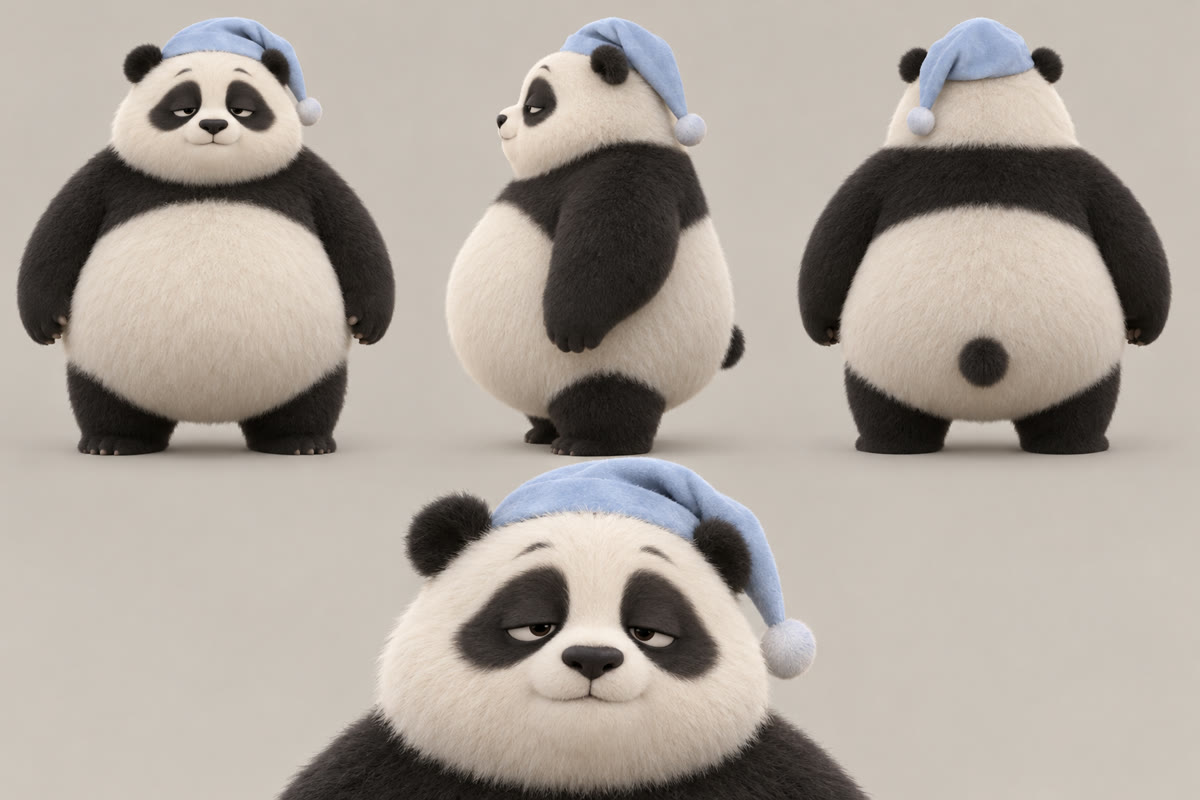
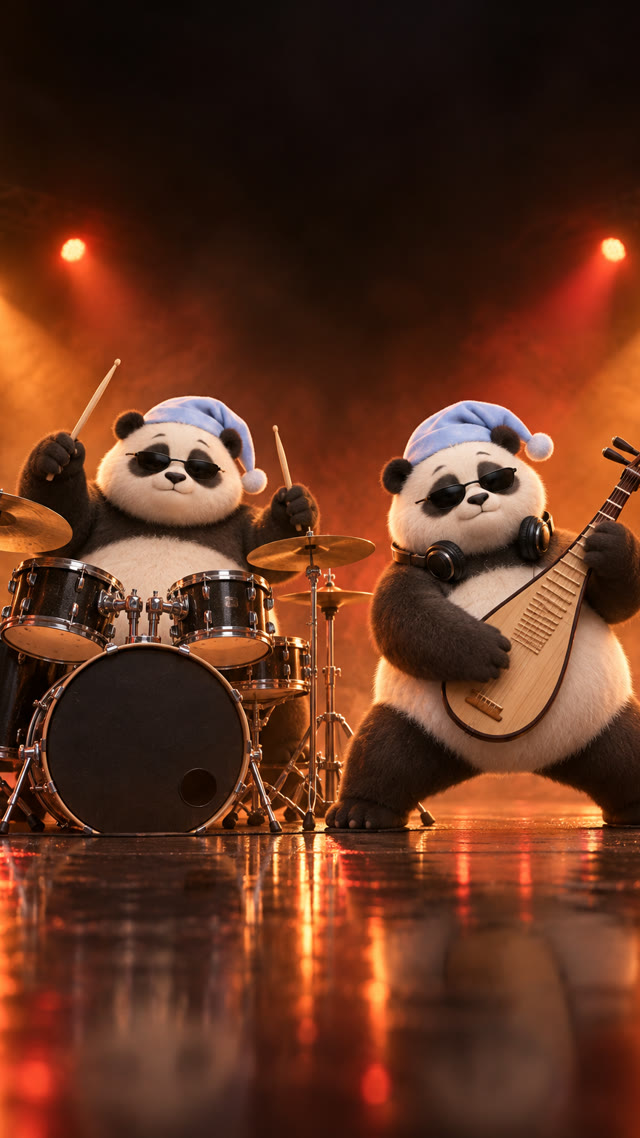
The video has two worlds. It opens as a podcast, with two PanPans in armchairs, and it ends as a band. We drew six stills: one for each chair, a wide shot of the band, the singer from two distances, and the drummer.
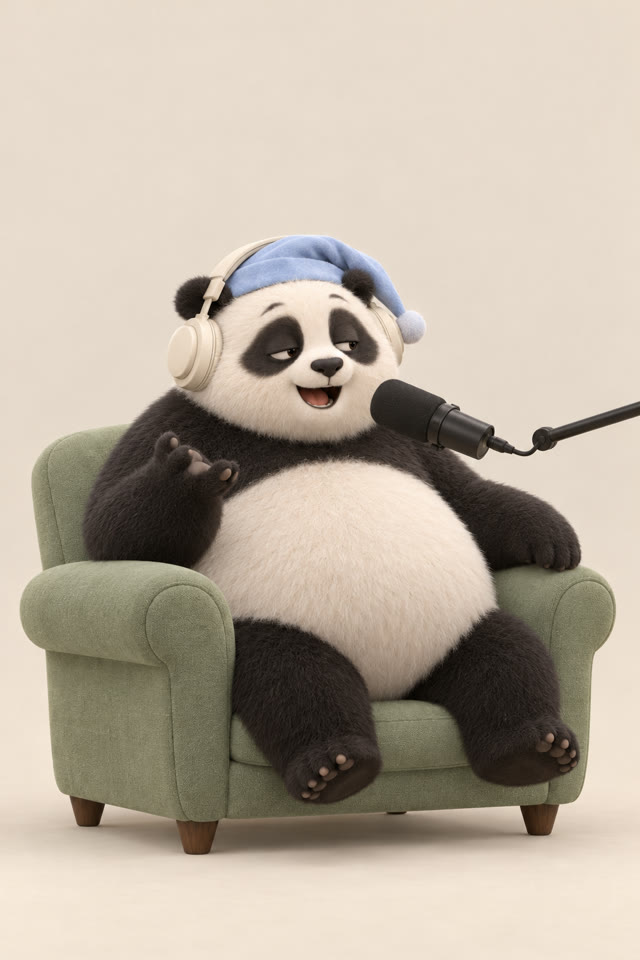
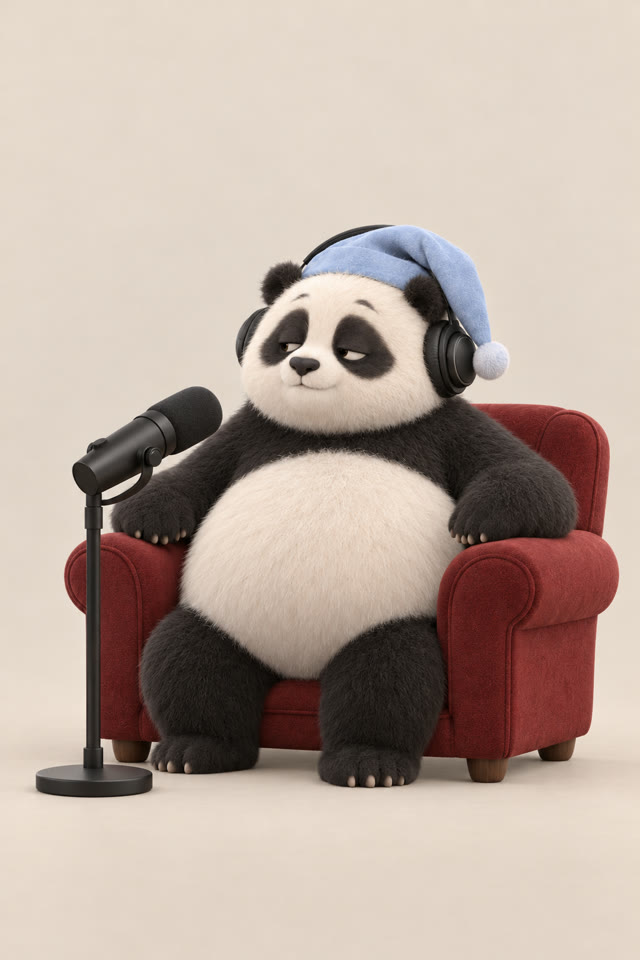
The panda sits sunk into a small sage-green armchair, wearing big cream over-ear headphones over his nightcap, talking into a black podcast microphone on a short stand with a pop filter. One paw is raised in a casual 'right?' gesture, mouth open mid-sentence, one eyebrow up, smug and relaxed. Full body, centred, seen from the front. Soft 3D animated feature film look, plush fur, warm soft studio light. The character is the chubby grown-up giant panda from the reference sheet, exactly on model: big round belly, short stubby legs, small dark eye patches, sleepy half-lidded eyes, and his light-blue nightcap with a pom-pom. Vertical 9:16 composition. Plain warm cream paper-coloured backdrop with a soft floor shadow, nothing else in the room. Keep the top third of the frame empty for a caption. No text, no logos, no watermark.
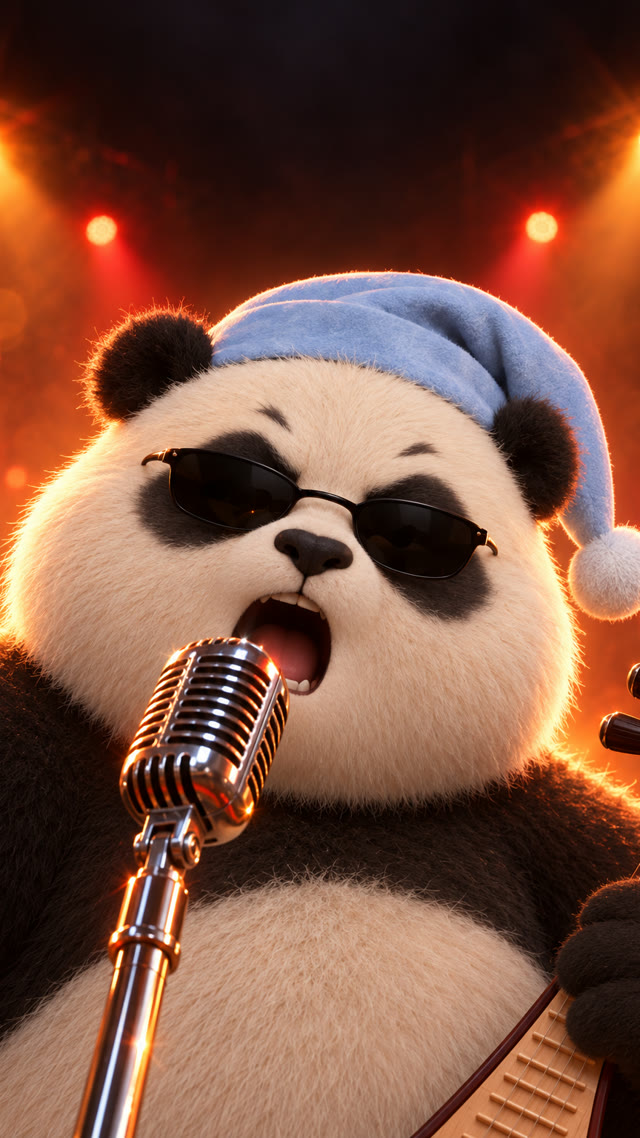
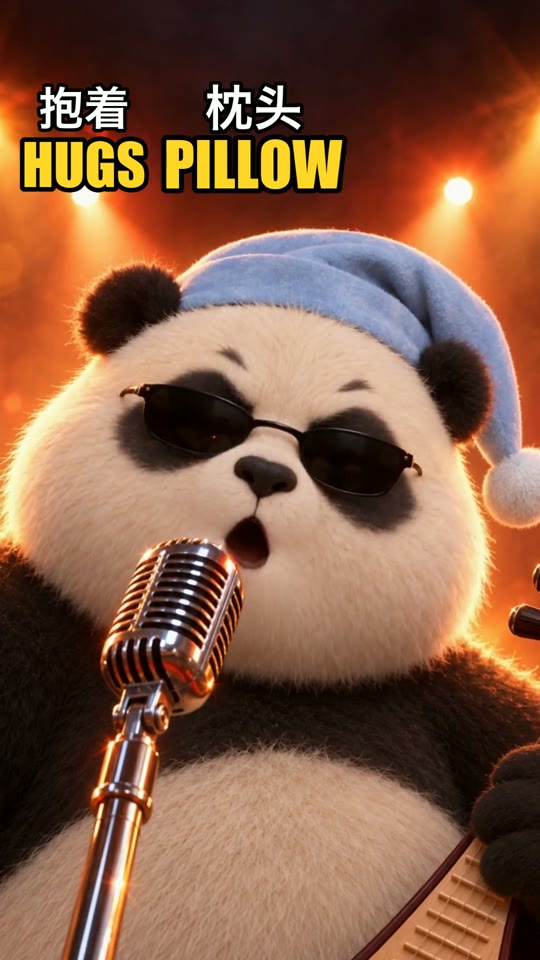
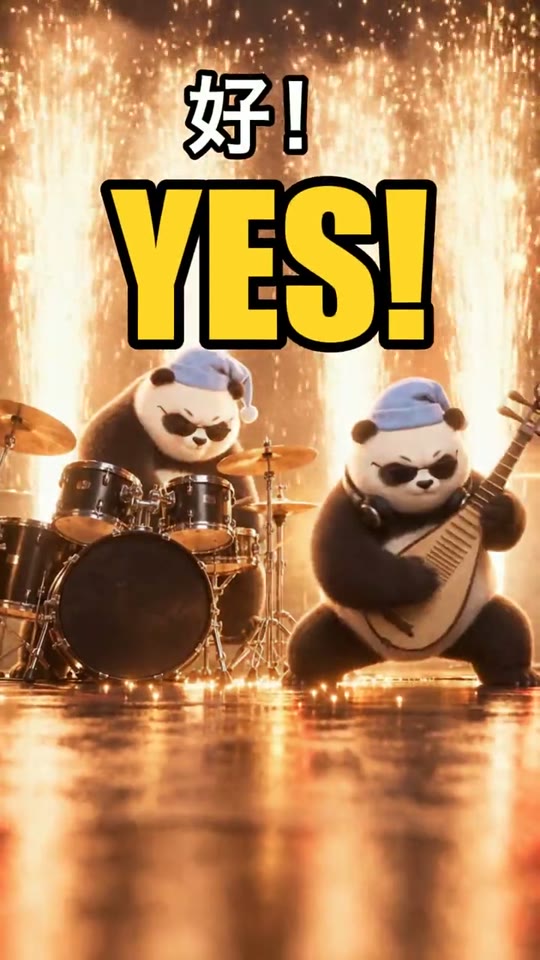
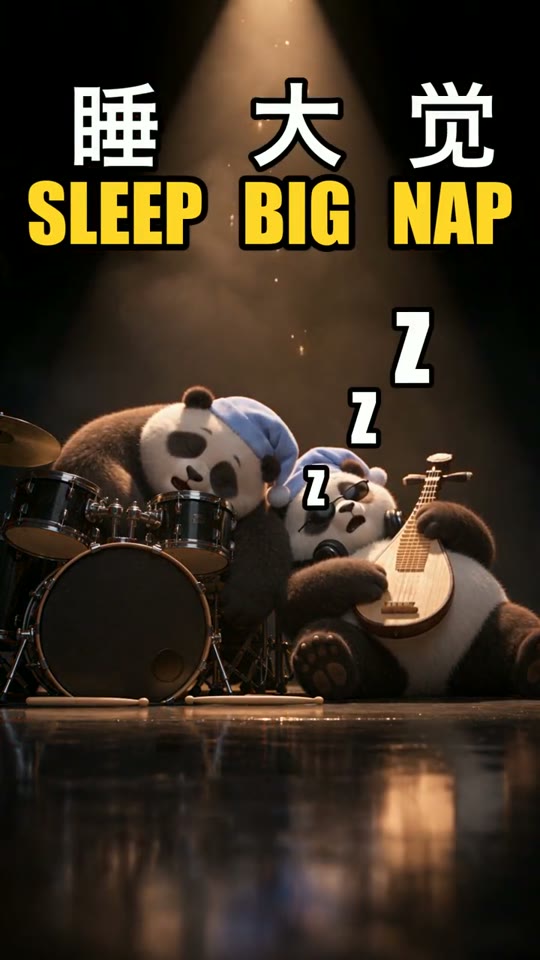
Two identical copies of the panda as a two-man band, both looking badass and totally serious. On the left, one sits behind a full drum kit, mid-hit with drumsticks raised, wearing small black sunglasses and his light-blue nightcap. On the right, the other stands in a wide rock stance playing a pipa, the pear-shaped Chinese lute, held like an electric guitar, wearing small black sunglasses, big headphones round his neck and his light-blue nightcap. Dark stage with warm amber and red spotlights from behind, light haze, glossy floor reflections, low camera angle. Soft 3D animated feature film look, plush fur. Both pandas exactly on model from the reference sheet: chubby, round belly, short stubby legs, small dark eye patches. Vertical 9:16 composition with both fully in frame in the lower two thirds and the top third darker and empty for a caption. No text, no logos, no watermark.
Two details save work later. Ask for a plain backdrop in the talking shots, so two clips can sit in a split screen without a seam. And ask for the top third to stay empty, so the captions have somewhere to go.
Animate each still with Seedance
Seedance turns a still into a clip. You give it the still as the first frame and describe what happens. We used Seedance 2.5 at 720p through OpenRouter, in clips of 4 to 14 seconds.
Describe one clear action, say what the mouth is doing, and lock the camera. A camera that drifts makes clips impossible to cut together.
The deadpan panda has just heard something ridiculous from someone off-screen to the left. In the first second he slowly lifts one eyebrow and tilts his head. Then he turns his eyes to the camera in a slow, flat side-eye, as if to say 'what is he talking about', holds it for a second, and looks back to the left, unimpressed. His mouth stays closed the whole time. Static locked-off camera, the framing never changes. Plain cream backdrop. Soft 3D animated feature film look. No text, no subtitles.
The show is over and both pandas fall asleep on the spot, within the first two seconds. The drummer panda drops his sticks and slumps forward, face down on the snare drum. The other panda sinks to the floor, lies on his side hugging the pipa like a pillow, sunglasses slipping askew, and is instantly fast asleep. Their bellies rise and fall slowly as they snore. The stage lights dim to one soft warm spotlight and a few last golden sparks drift down. The camera slowly pushes in. Funny and peaceful. Soft 3D animated feature film look. No text, no subtitles.
Reactions are what make it feel like a conversation. The second PanPan never says he is unimpressed. He lifts one eyebrow, and later he gives one very small nod. That nod took three rounds, because the model kept making it bigger than we asked.
Match the mouth to the words
This is the hard part, and it is where most of the time went. We could not simply hand Seedance the song and have it move the mouth in time. So we used a trick: have the character say the words, then stretch the clip to fit the song.
- Generate the clip with sound switched on and the exact line in quotes. The model now moves the mouth for those words. You throw its sound away afterwards.
- Find when each word starts in the clip. Whisper gives you word times from the clip's own audio.
- Find when each word starts in the song. Demucs separates the voice from the music, and Whisper times the words in the voice.
- Speed the clip up or slow it down between words so each mouth shape lands on its word in the song.
The smug, relaxed panda talks into the podcast microphone toward the right, with small paw gestures. He says: "Try this." He pauses. "The panda gets up early and puts on his little hat." He pauses. "He eats buns till he's full, soaks in the bath, and won't run." He pauses. "Then he hugs his pillow and goes back to sleep." Static locked-off camera, the framing never changes. Plain cream backdrop. His mouth is clearly visible and forms every word. Soft 3D animated feature film look. No music, no subtitles, no text.
The panda front man raps in Mandarin Chinese into the stand microphone, head bobbing hard to a beat, totally serious. He raps four quick lines: "熊猫起得早,戴好小睡帽,吃包吃到饱,泡澡不想跑," then "抱着枕头" and then he belts three long held notes, holding each one for a full second with his mouth wide open: "睡——" "大——" "觉——". Then he closes his mouth and nods. His mouth is clearly visible and forms every syllable. Spotlights strobe behind him. The camera keeps the same framing the whole time. Soft 3D animated feature film look. No subtitles, no text.
Long held notes need their own take. When we slowed a normal clip down to cover “睡——大——觉”, PanPan looked frozen. So we asked for a clip where he really holds each note, and described the mouth shape for each one.
The panda front man sings one line in Mandarin Chinese into the stand microphone in a single breath, totally serious. For the first half second his mouth is closed. Then he raps four quick syllables in under a second: "抱着枕头". Then, without closing his mouth and without any pause, he sings three long held notes that flow straight into each other: "睡——" held for one second with rounded lips, then "大——" held for one second with his mouth wide open, then "觉————" held for a second and a half, the loudest, mouth wide open. Only at the very end does he close his mouth. His mouth is clearly visible the whole time and his head keeps bobbing to the beat. Spotlights strobe behind him. The camera keeps the same framing the whole time. Soft 3D animated feature film look. No subtitles, no text.
Cut it and caption it
The edit was done in code, with Python and ffmpeg, but every choice below works the same in CapCut or any other editor.
- Split screen for the conversation. The two podcast clips are stacked, one above the other. Each PanPan was generated alone on the same plain backdrop, which is why it looks like one room.
- Fewer cuts in the song. Our first band section cut far too often and felt nervous. The final one stays on the singer for whole lines.
- Sing every line on screen. When the hook starts, the viewer wants to see the mouth that is singing it.
- Cut the song down. The full song is 85 seconds. The video jumps from the end of the slow sentence to the second chorus and runs 58. It still plays as one song.
- End on the joke. The last line means “sleeps a big sleep”, so both pandas fall asleep on stage.
The captions change with the section. In the word list, one big word appears at a time, English above and Chinese below with its pinyin. In the song, each Chinese word sits over its English meaning, so you can follow the rap without speaking Chinese. One line gets a caption of its own.
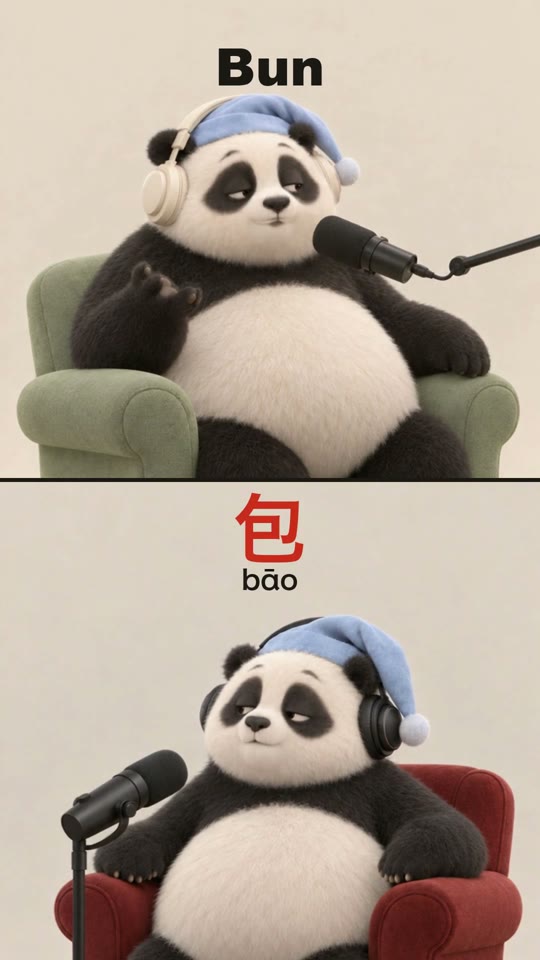
For the cover we used the first shot, PanPan in his chair, with the question as two lines of text. It tells you the joke before you press play.
What it cost
These are the real totals for everything we generated, including what we threw away.
| 13 songs | $0.78 |
| 11 images | $0.82 |
| 41 video clips | $57.43 |
| Total | $59.03 |
Almost all of the money is video, and most of the video money went on second and third tries. About a third of the clips are in the final cut. If you want to spend less, settle the song and the stills first, because those are nearly free, and only then start animating.
Or let Spinoff do the steps
We made this video by hand because we wanted to learn where the hard parts are. Spinoff is the studio we are building from what we learn: you give it a reference and an idea, an agent works through these steps, and it stops at the script, the look, the video and the final package for you to approve.
Get an email when it opens.